
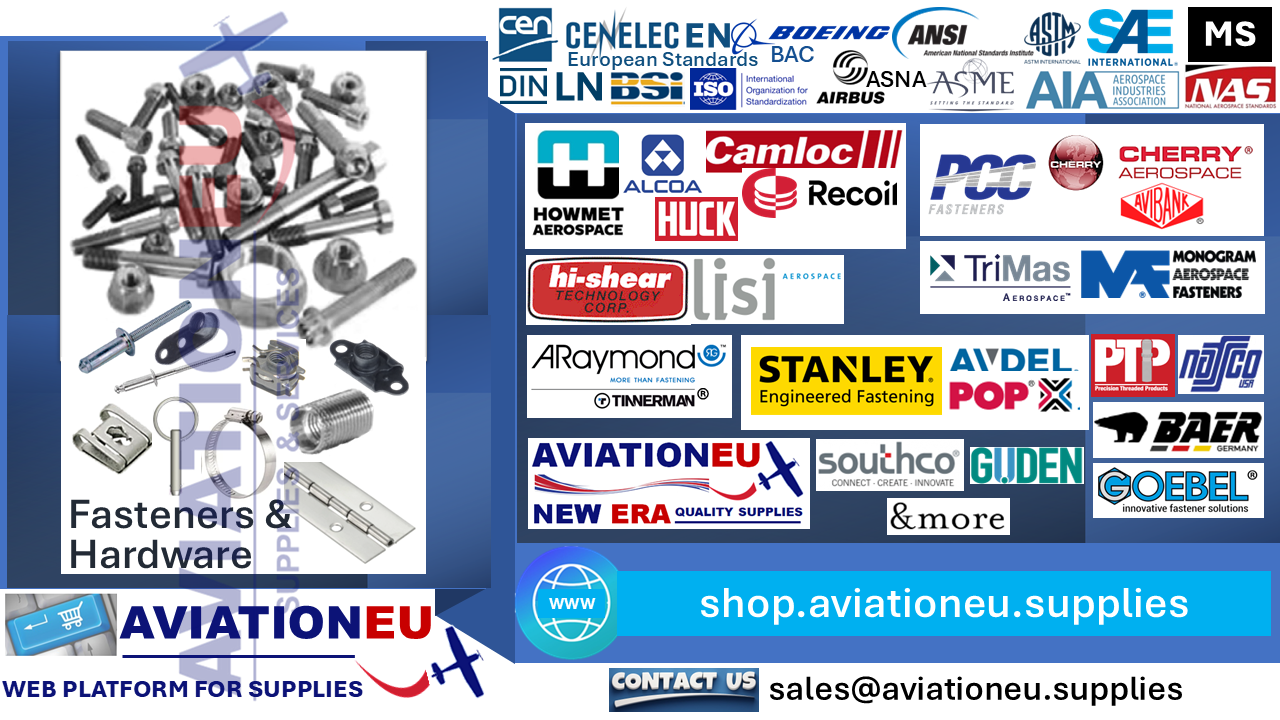
Fasteners and fastening hardware are general terms denoting a wide range of products used to mechanically join or affix two or more objects together in military, aerospace and numerous industrial applications. Such products include but are not limited to screws and bolts, nails, nuts, rivets, cotter pins, turnlock fasteners, metal washers, clamps, or other hardware components such as control cable hardware, safety wire, or hinges used for connecting two solid objects (like a door and frame) while allowing a limited angle of rotation.
They conform to different military/aerospace (*) and industrial (commercial) specifications (standards), and come in countless combinations of types, styles, materials, finishes, specifications, sizes / dimensions or other characteristics. They are offered both under different brands of their respective manufacturers or as part of our own branded (AVIATIONEU NEW ERA) product lines. Although it's impossible to include them all in a comprehensive guide, some commonly used broad categories are outlined below as an overview of these fasteners and hardware, with emphasis on those of military/aerospace uses. More information is available in this Repository or specific product presentations at our Web Platform for Supplies.
(*) U.S Aerospace/Military Fastener Standards include Army-Navy (AN), predecessor to "Military Standard " (MS) and subsequent NAS (National Aerospace Standard) which followed.
Army-Navy Standards (AN) - Predecessor to Mil-Spec (MS), AN fasteners were the industry standard for aircraft, indicating that these fasteners were made to military specifications to stand up to demanding applications without faltering.
Military Standards (Mil-Spec, MS) - United States Defence Standards used to achieve standardization objectives by the U.S. Department of Defence. Also used by other non-Defense government organizations, technical organizations, and industry.
National Aerospace Standards (NAS) - administered by the U.S Aerospace Industries Association (AIA).
AIA, in coordination with the US Department of Defense, has converted a number of MIL-spec's to NAS. Prefixes such as “NASM” are used for fasteners based on inch measurement system while "NA" or “NAM” for Metric fasteners. NAS standards include part standards for high strength, precision fasteners.
All fasteners are identified with a specification number and a series of letters and dashes identifying their size, type of material, etc. This system presents a relatively simple method of identifying and cataloging the thousands of hardware items, several of them coming both an AN number and an MS number that are used interchangeably to identify the exact same item. Cross reference tables have been created and are currently used. More information on these Standards can be found in our respective article.
Screws and Bolts
Screws and bolts are common threaded fastening devices with screws differing from bolts as they are generally made of lower strength materials. They can be installed with a loose fitting thread, and the head shapes are made to engage a screwdriver or wrench. Some screws have a clearly defined grip or unthreaded portion while others are threaded along their entire length. Several types of structural screws differ from the standard structural bolts only in head style. The material in them is the same, and a definite grip length is provided.
Commonly used aerospace screws are classified in three groups:
(1) Structural screws, made of alloy steel, which have the same strength as equal size bolts;
(2) Machine screws, usually of flathead (countersunk), roundhead, or washer head types. These screws are general purpose screws for general repair and are available in low carbon steel, brass, corrosion resistant steel, and aluminum alloy; and
(3) Self-tapping screws, used for attaching lighter parts. A fourth group, drive screws, are not actually screws but nails. They are driven into metal parts with a mallet or hammer and their heads are not slotted or recessed.
Nuts and Anchor Nuts
Nuts are also extensively used in a wide range of aerospace and industrial applications. They are divided into different groups such as self-locking and non-self-locking hexagonal nuts or anchor nuts (aka nut plates).
Non-self-locking nuts are those that must be safetied by external locking devices, such as cotter pins, safety wire, or locknuts. Self-locking nuts contain the locking feature as their integral part. Anchor nuts (aka nut plates) are designed for blind mounted applications where it is impractical to use hexagonal nuts and are available in different types (fixed or floating, one lug, two lugs, corner, etc.).
Aerospace/Military nuts commonly used in aircraft applications are usually made of cadmium plated carbon steel, stainless steel or aluminum alloys and structured in different series based on the standard they conform(*). Non Military (Commercial) nuts meet DIN, ISO and other standards.
Rivets and Lockbolts
Rivets and lockbolts (aka lockbolt rivets) are two of the most common permanent mechanical fasteners in the modern manufacturing and assembly industry. Both can achieve a secure connection, although they have significant differences in their use, structural strength, installation methods, maintenance cycles, and overall costs.
Lockbolts are ideal for high-stress / high-loads environments offering greater strength and reliability while rivets are more commonly used as connectors for general joining needs in lighter applications where ease of installation is a priority.The choice between lockbolts and rivets depends on the specific material properties and application requirements, including strength, installation conditions, and cost considerations.
Other Fasteners
Pins, clamps, nails, springs, studs, grommets, retainers, machine keys, and other fasteners not listed elsewhere.
Pins are manufactured and stocked in a variety of styles, materials, and lengths. Some of the more common styles (types) include clevis, cotter, cotterless, dowel, roll/spring, groove, hitch, tapered, coiled, hairpin, and adjustable. For more information please consult our respective article and related documentation.
Hinges
Hinges play a crucial role providing a smooth pivot mechanism for doors, panels, cabinets. They are considered crucial, load-bearing door hardware components, supporting weight and enabling their easy opening/closing in a wide range of applications in aerospace, car, construction, furniture, and many other industries.
They are offered in different types including:
Continuous (aka Piano) hinges runing the full length of a door, panel or other applied surface, providing uniform support and stability,
Butt hinges (most common type),
Spring hinges with an integrated spring mechanism,
Other types such as Concealed hinges, Ball bearing hinges with ball bearings between the knuckles, Heavy-duty hinges, designed for industrial and heavy-load applications, or Specialty hinges for specific applications, such as offset hinges and lift-off hinges.
Although characteristics and specifications vary depending on the selected hinge, great emphasis is placed so that those falling under our offered product range exhibit most of the following features to become the preferred choice for our customers' hinge applications.
High-Quality Materials such as stainless steel, aluminum, and brass, for their longevity and resistance to corrosion,
Robust Construction for handling heavy loads and constant use,
Easy installation with different mounting options in various orientations to suit your specific requirements,
Rich collection of sizes, configurations and load-bearing capacities to meet application requirements,
Low Maintenance, smooth operation, security and reliability.
Applications:
Intended for use in a wide range of applications across various industries, including, but not limited to:
Aerospace industry, industrial machinery, electronics and cabinets, transportation, commercial buildings, furniture and cabinetry and others.
MS20001 and MS20257 Series hinges are commonly used in commercial and military aircraft and meet stringent aerospace industry standards, ensuring exceptional performance in aerospace applications.
For additional information please refer to the respective product presentations at our Web Platform for Supplies (shop.aviationeu.supplies).